
ALCHEMY ZOSI · ENTERPRISE PRODUCT DESIGN
Structuring Safety Training for Better Learning Outcomes

OverView
Lets understand the system.
The platform delivers Environment, Health & Safety (EH&S) training for manufacturing organizations. These courses are often mandatory and tied to regulatory compliance, requiring employees to complete specific training modules to maintain certification.
The system supports both course creation and course consumption, enabling organizations to configure training programs and distribute them to employees across teams
Problem Discovery
What We Observed After Launch of Phase 1
Administrators typically design these programs with a clear learning sequence, starting with foundational concepts and progressing toward more specialized procedures.
However, the platform delivered courses as a flat list of modules, without hierarchy or progression logic.
As organizations began creating longer courses, several behavioral patterns emerged in how learners interacted with training.
Lack of Course Structure
Courses appeared as long lists of modules with no grouping or hierarchy.
Learners struggled to understand:
-
how topics were organized
-
how modules related to each other
Certification Without Learning Path
Learners could jump ahead to the modules required to complete the course and receive certification, bypassing foundational training material. This meant completion records did not always reflect the intended learning progression.
Unrestricted Navigation
Learners could open modules in any order.
In practice, many learners skipped earlier modules and moved directly to later content.
Compliance Risk for Organizations
For safety training, sequence often matters.
Skipping prerequisite modules weakens training outcomes and creates risk for organizations relying on the platform for regulatory compliance.
These behaviors revealed a gap between how training was designed by administrators and how it was experienced by learners.
OPERATIONAL REALITY
How Training Flows Through the System
Training programs move across multiple roles and systems. Administrators configure course structure in the admin portal, training managers assign courses, and employees complete modules in the learner portal.
The diagram below illustrates how training flows across portals and roles within the platform.

Design Focus :
Course structure is defined entirely within the admin platform, but experienced within the learner portal. While multiple roles interact with the system, this project focused on improving:
• Course configuration for Super Admins
• Training consumption for Learners
This meant solving the problem required designing changes across both systems.
PROCESS
How we approached this project?
A structured approach from research through
wireframing to validate decisions at each stage.
01
Desk Research
Reviewed patterns used in learning platforms such as LMS systems and course platforms to understand how sequential progression and module locking are commonly implemented.
02
Stakeholder Discussions
Aligned with product and internal stakeholders to understand training requirements and administrative workflows.
03
Early Concepts
Explored different ways of structuring course content including grouped modules, collapsible sections, andlearning paths.
04
Wireframing and final design
Created early structural wireframes to test course hierarchy and progression logic across admin and learner platforms.
Key Insights from Research & Stakeholder Discussions
Learners prioritize certification completion
Many learners focused on completing required training quickly, often jumping to modules that unlock certification.
Administrators structure courses conceptually
Administrators naturally grouped modules by topic, even though the system did not support sections.
Training completion ≠ learning progression
Completion records did not guarantee learners followed the intended sequence of training.
This process helped frame the problem as a course architecture challenge rather than a simple interface change.
DESIGN OPPORTUNITY
Defining the design direction
Addressing the issue required more than preventing learners from skipping modules. The platform needed a way to represent structured training programs while maintaining flexibility for administrators managing different types of courses.
Any solution needed to:
THE SOLUTION NEEDED TO
01
Create clear hierarchy for
training content
02
Guide learners through required learning paths
03
Remain flexible for
administrators
04
Work across both admin & learner systems
01
Create Course + Add Information, Course Image
→
02
Add Sections
→
03
Add Modules
→
04
Enable Sequential Progression
→
05
Publish Course
DESIGN DECISIONS
1. Introducing Course Hierarchy
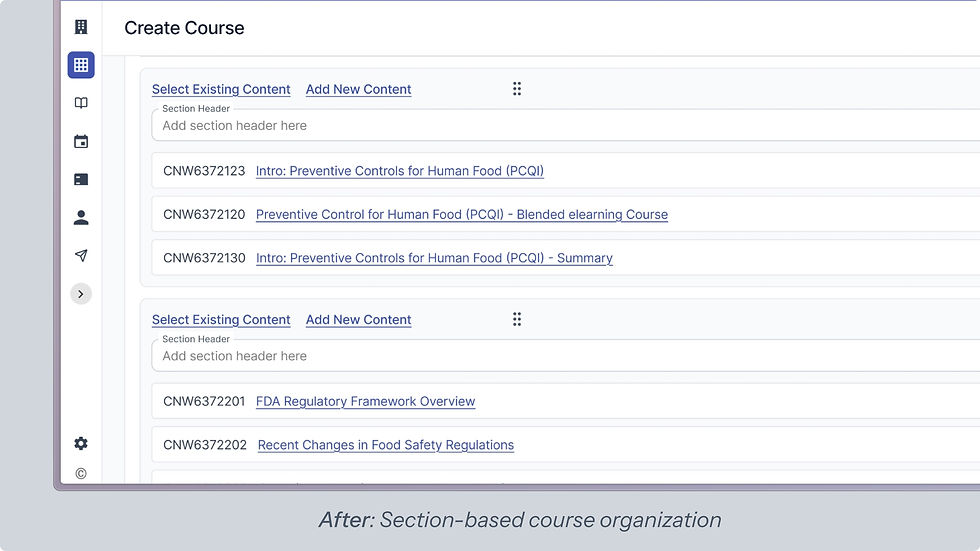
Flat module lists made longer training programs difficult to navigate. Administrators needed a way to organize related modules while learners needed clearer course structure. We introduced section-based course organization
Admin Portal Implementation
Administrators can create section headers and group related modules when authoring a course.
Workflow:
Create Course + Add Details → Add Section → Add Modules → Publish

.jpg)
Learner Portal Implementation
.jpg)

DESIGN DECISIONS
2. Guiding Learning Through Sequential Progression
Learners were able to skip modules and jump directly to certification content. To address this, We introduced configurable sequential progression.
Admin Portal Implementation
Administrators can enable progression rules that require learners to complete modules in sequence.
Learner Portal Implementation
Modules unlock progressively as learners complete required content, ensuring foundational training is completed first.
.jpg)
IMPACT
Key outcomes
01
Improved Course Readability
02
Guided Learning Progression
03
Scalable Course Architecture
REFLECTION
This project highlighted how product challenges often surface as systems scale. While the flat module structure worked for the MVP, real-world usage revealed that learners could skip foundational modules to complete certifications quickly.